
Find Marin County Residents
No single roster makes up the Marin County residents directory. It is a set of records, each with its own custodian and meaning. An assessor record names a parcel owner and may give a tax mailing address. A recorded deed lists the parties to an instrument. A court index names a case party. A directory entry can place a household at an address in a given year. None of these alone proves who currently lives at a property.
Begin with the strongest fact you hold. An address opens MarinMap and yields an APN. A name can point to the recorder, the courts, licenses, business filings, or vital records. Family-history questions tend to need the California Room, historical society files, census material, and obituaries. An empty online result signals a change of custodian. It does not mean a person or property has no record.
- Locate the address in MarinMap, capture the APN, and identify whether the parcel is in a city or unincorporated Marin.
- Use the APN in the county assessor application, then keep the situs address separate from the mail-to name and mailing address.
- Search the recorder by party name and spelling variants, because its index does not accept a street address or APN.
- Check the Marin Superior Court ePortal, vital-record rules, or an official state lookup when the question concerns one person.
- For an older household, use the California Room, Marin History Museum, census, newspaper, and directory collections, then request a missing administrative record through Marin County’s public-record process.
Worked in order, the sequence builds a dated evidence trail. It flags restricted records. It also flags sources that name an owner rather than a current occupant.
Marin County Records Offices
The Assessor, Recorder, and County Clerk share one Marin County office, but each division answers a different question. The Recorder indexes deeds, liens, and maps. The Assessor keeps parcel identifiers, assessment data, and maps. The County Clerk files marriages and fictitious business names. Elections holds controlled voter data. Superior Court keeps probate and case files. The Marin County Assessor-Recorder-County Clerk page is a starting point for several record types, not a single resident search box.
Marin County Recorder
3501 Civic Center Drive, Suite 232
San Rafael, CA 94903
415-473-6092
Marin County Assessor
Marin Civic Center public counter
San Rafael, CA 94903
415-473-6092
Marin Elections
3501 Civic Center Drive, Suite 121
San Rafael, CA 94903
415-473-6444
Online indexes stop at dates, hide images, or demand a record request, and then in-person help matters. Room 232 holds the Recorder's older document research. The campus keeps several custodians close together. Access, certification, redaction, and correction still rest with the responsible office.
Why Marin County Records Split
Marin County contains eleven incorporated cities: Belvedere, Corte Madera, Fairfax, Larkspur, Mill Valley, Novato, Ross, San Anselmo, San Rafael, Sausalito, and Tiburon. Unincorporated communities fill out the rest. A postal place can cross a city limit, a school boundary, or an assessor tax area. So a permit, court, tax, deed, or election question may move among county, city, state, and federal systems.
One name can appear many ways. It may show up as grantee, taxpayer, case party, business agent, or voter. Those are evidence labels. They are not interchangeable identities. A Marin County residents directory result stays reliable only with its source, date, role, and custodian attached. Keep those labels close.
| Official source | Best question | Important limit |
|---|---|---|
| Assessor roll | Which parcel and taxpayer record are connected? | Mailing address is not proof of residence. |
| Recorder index | Which parties signed or received a recorded instrument? | Index is not the deed image and cannot search by address. |
| Directory or census | Who was listed at an address in an earlier period? | Unlisted households and gaps are common. |
| Commercial compilation | What lead might need checking? | Names and addresses can be stale, merged, or mislabeled. |
Official does not mean complete. A compiled result does not become official just because it looks current, and the record trail decides what a finding can support.
Start With Marin County Records
Marin's public assessor application is APN-first. It offers no public owner-name or street-address directory. The APN bridges a map to a roll, but it is an assessment locator rather than a postal address or full legal description. A county example follows the eight-digit pattern 123-456-48. The first three digits name the map book. The next two name the page. That numbering helps a researcher open the right scanned parcel map.
Accept the Revenue and Taxation Code warning before searching. The roll can hold situs, mail-to, value, use, units, exemptions, and roll-year fields, though property characteristics exist for assessment and are not continuously updated. Carry the APN into the Recorder, permit viewers, or a city system only after checking jurisdiction.
| Parcel Number | Required for roll lookup; use the county’s eight-digit APN format. |
|---|---|
| Map Book | Required for map lookup; the first map-reference component. |
| Map Page | Added when a specific scanned map sheet is needed. |
| Accept / Decline | Accept opens the search; decline does not. |
| Result limit | The public application can cap a search at 100 results. |
- Roll
- An assessment record describing a parcel, its taxable values, use, and related mail-to fields for a roll year.
- Index
- A finding aid that points to a fuller record; it is not the deed, court file, or certificate itself.
- Parcel
- A mapped unit of land identified by an APN, which can change when land is split or combined.
- Criss-cross directory
- An address-order directory that works from a place toward an occupant name rather than from a name toward an address.
Note: An APN organizes Marin County property research, yet it never identifies every person who occupies the parcel.
Marin County Parcel Records
MarinMap turns an address into a map feature first. Search for the place, pick the suggested location, and switch on the parcel and address layers. A click on the polygon pops up the APN. Pan along a street to compare adjacent parcels. Measure tools give rough context only. Remember the warning from Marin GIS: the maps are informational and not survey accurate, so no display proves a boundary or supports a title claim. Jurisdiction is the second detail worth capturing. A postal San Rafael address can sit inside San Rafael or in unincorporated Marin. The 94941 postal zone extends past incorporated Mill Valley. Likewise 94965 pairs Sausalito with unincorporated Marin City. County CDA viewers cover unincorporated property, while a city or town system covers land inside municipal limits. Write down the address, APN, postal label, and permit keeper together before leaving the parcel record.
Address → MarinMap parcel → APN and jurisdiction → assessor roll → recorder name search → permit or directory evidence.
Marin GIS layers roads, zoning, hazards, districts, aerial imagery, and more as open data. Those layers enrich a resident lookup. They never turn the map into a household list. Context is their whole job, and a residents directory result still needs a record behind it.
Current Marin County Resident Sources
Current sources in the Marin County residents directory follow different access rules. Every residents directory result makes sense only when you know what its source actually is. The assessor application starts from a parcel number. The Recorder's Official Records Search is a free index. The index is not the image behind it. California's My Voter Status tool works as an identity-matched self-check rather than a reverse directory. A court result is a case record, not a residence record. Libraries and the historical society matter when "current" means recent past. Match the source to the question.
| Source | What it can connect | Keeper | Access posture |
|---|---|---|---|
| Assessment roll | APN, situs, owner/mail-to fields, values and use | Marin Assessor | APN web search; broader data may require counter or request. |
| Recorded index | Grantors, grantees, dates, document references | Marin Recorder | Free index; paid copies and older-room research. |
| Voter status | One voter’s registration and election status | California Secretary of State | Identity-matched self-lookup; bulk data is restricted. |
| Superior Court index | Case parties, numbers, events and eligible documents | Marin Superior Court | Account, daily limit, and case-type restrictions. |
| Local collections | Past households, relatives, places, and obituaries | California Room and Marin History Museum | Online catalogs, digitized items, email, or on-site use. |
Pick the source that fits the question. Then verify against a second independent anchor such as an age, middle name, old address, relative, or dated document. That habit beats a long list of unverified names.
Marin County Recorder Records
Marin's Recorder index behaves like a catalog. Search party names, document references, book and page data, or document and map criteria. Try every reasonable spelling variant too. Street addresses and APNs are not accepted. The online index reaches from January 2, 1973 forward. Older documents wait in Recorder Room 232 at the Civic Center. An entry can point to a deed or deed of trust. It may also be a reconveyance, lien, release, easement, notice, or recorded map. Still, an index line alone proves neither possession nor occupancy.
Read each online result as a set of clues. Expect party and role, plus instrument type. Recording date, reference number, and book and page or map reference may appear. So may any cross-reference. The legal description, vesting language, and signature are not online. Nor is the full parcel relationship. Those require the paid instrument or a counter inspection. Official-record copies cost $4 for the first page. Each additional page costs $2. Certification adds $4. Map copies run $5 per page. Certification adds $4, and certified copies cannot be emailed. The Recorder document and map order form handles those separate requests. The county's official index page displays its search modes directly. Open the Marin County Recorder's Official Records Search for the entry point.
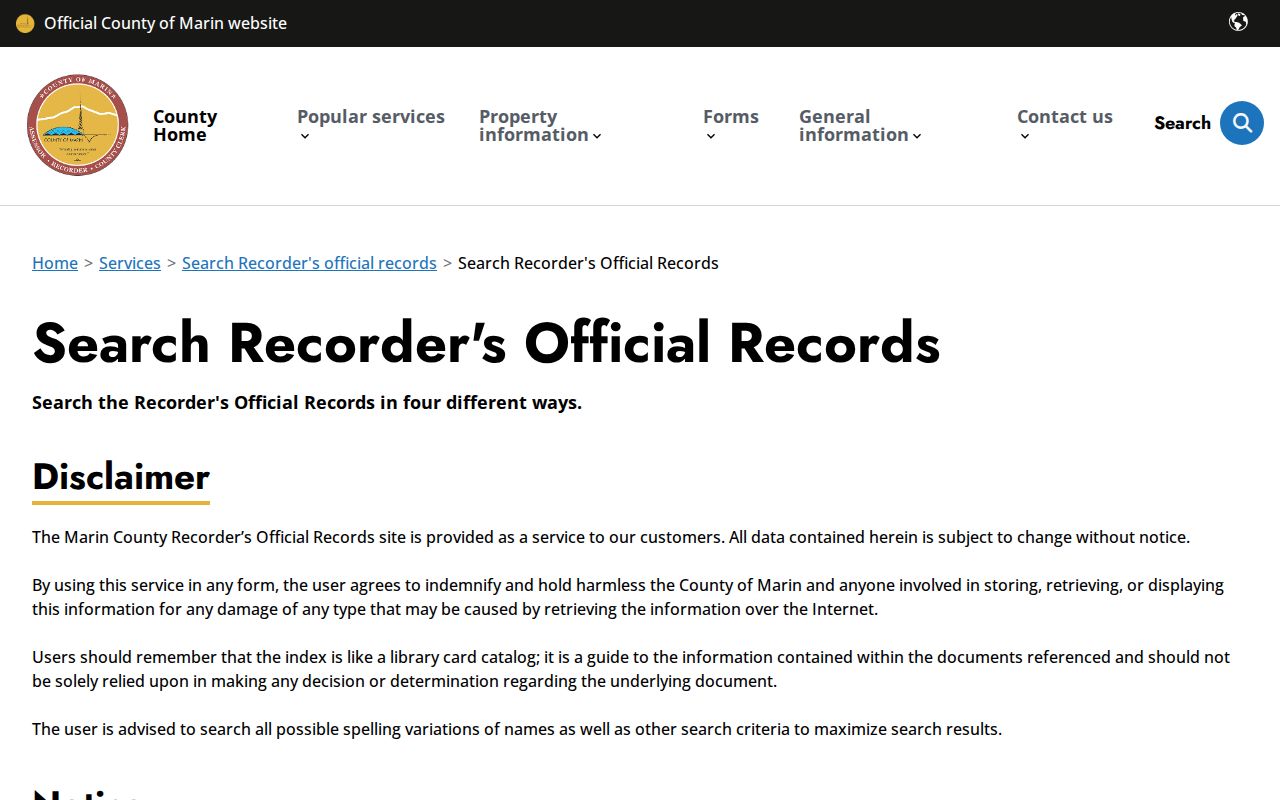
The image shows the catalog step. A name is only a lead. It still needs a dated instrument, a legal description, and a second source before it supports a resident-history conclusion. Note: A free index entry and a certified copy answer different questions, so record both the reference and the access level.
Marin County Voter Records Limits
My Voter Status works for one voter at a time. California's tool asks for identity fields. It can return registration status, party preference, county, districts, precinct, and election information. It cannot be browsed by street, ZIP, or block as a public resident list. Marin treats the underlying voter data as restricted. These voter rolls are no casual lookup.
An approved election, political, scholarly, journalistic, or governmental requester must submit identity and contact information, purpose, requested geography or product, and supporting material. They must also provide an original signature, date, and a security acknowledgment. A request for specific voters may cover no more than ten people. Review can take up to ten business days. Approved active-voter data then arrives through secure delivery as tab-delimited text or PDF. Safe at Home and other confidential voters stay shielded. Ballot choices are never supplied.
So call the California My Voter Status lookup a self-service status check. It is no substitute for a voter roll. Never use it to infer ballot choices or a current household. View the California voter-status form for the identity-matched route. The state form itself shows why a person's own inputs are required.
The state form belongs to the voter, while Marin's controlled file process belongs to approved statutory-purpose requests. Keeping those routes separate protects both accuracy and privacy.
Confirm Marin County Court Records
Marin Superior Court’s ePortal ties a name to a case party, AKA, case number, case type, filing date, register-of-actions events, hearings, status, and disposition. Eligible documents appear there too. The public route needs an account and login. General users cap out at 45 cases a day. The court warns that new filings may lag. It also warns that remote access stays narrower than what a courthouse terminal shows. California has no single statewide trial-court party search. So a Marin trial matter lives with Marin Superior Court. The portal changed in 2023. Criminal matters filed after June 20, 2023 sit in the current ePortal. Earlier ones may remain in EJUS. Sealed files, juvenile matters, adoption and parentage records, and protected filings are excluded. Other confidential material is excluded too. A courthouse terminal can display a document remote users cannot see. Pull the case number and title from the public index first. Then request pages from the clerk. Marin Superior Court online services form the official gateway for these lookups. The court’s own services page displays the access rules that govern any request.
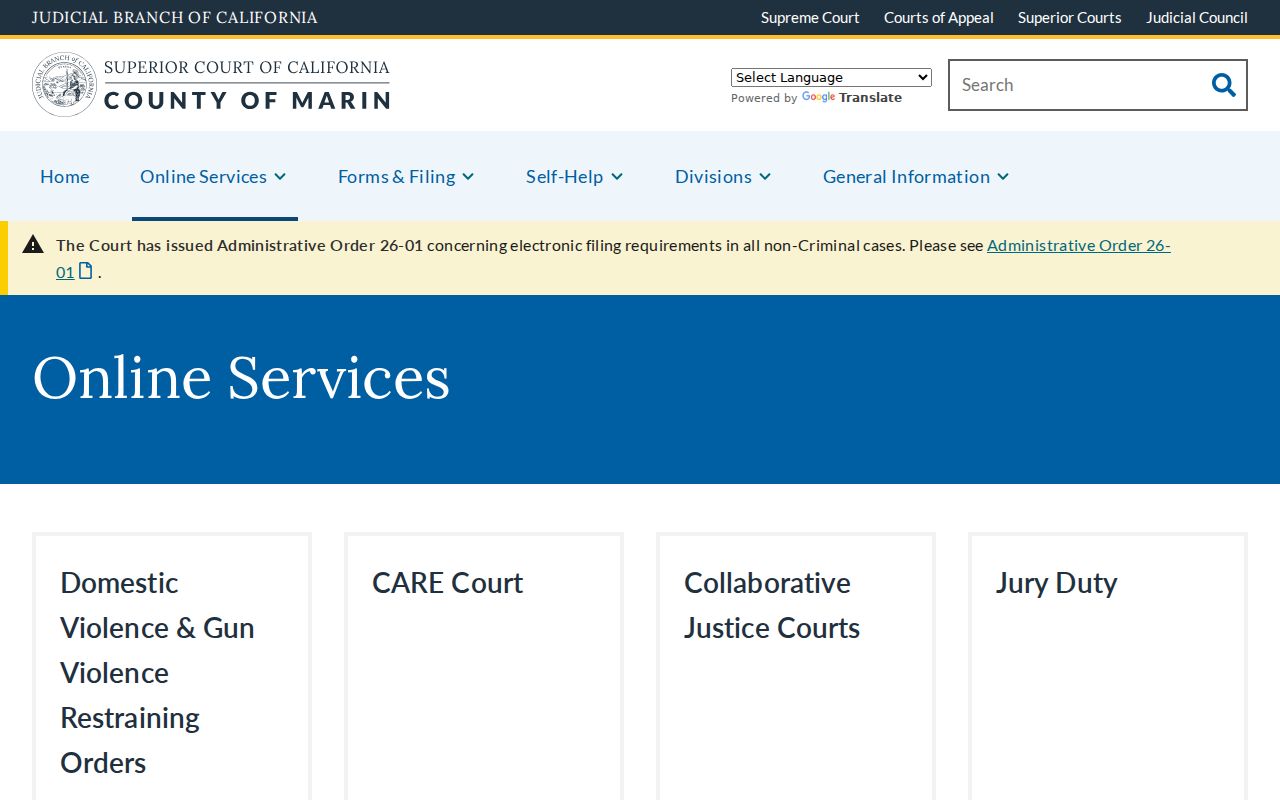
Room 113 remains the in-person fallback. The court’s physical or mail request process works too. A search running past ten minutes or an estate search costs $15, copies run $0.50 per page, and comparison costs $1 per page. Certification adds $40 per document, and certified dissolution records run $15. Those fees cover court service only. They do not fund a general resident lookup. Note: A court party shows a case relationship, not proof that the person lives at a Marin County address today.
Marin County Vital Records Clues
Marin’s Recorder issues birth and death certificates for county events. Coverage runs from the 1850s to the present. Public marriage certificates cover licenses registered in Marin. The newest six weeks of births and deaths are an exception. They may sit only with the Marin Office of Vital Statistics. The state Department of Public Health is the statewide custodian. It handles forms and access rules for records outside Marin. Divorce certificates differ from a full Superior Court decree. Authorized copies can establish identity for eligible applicants. Informational copies are certified but marked invalid for identity. Confidential marriage records generally go only to a spouse or a court-order recipient. A mailed authorized request needs a signed, notarized sworn statement. Listed 2026 copy fees are $31 for birth and $26 for death. A public or confidential marriage certificate costs $19. A CDPH divorce certificate runs $18. For family-history questions, vital records work best beside a dated address. An obituary, deed, or probate record also helps. They do not list living Marin County residents. Start with the county office for Marin events. The state’s California Vital Records information page explains the ordering route and copy distinctions.
Marin County Family Records
The Anne T. Kent California Room connects the Marin County residents directory to a long historical shelf. It holds business directories and phone books reaching back to 1878. Great Registers run from 1906 to 1974, with an index covering 1900 to 1932. A volunteer I.J. obituary index starts in 1970. Marin censuses span 1850 to 1930. The California Death Index covers 1940 to 1994. Farm deaths run 1881 to 1965. The WPA-era Flack’s Chronology index rounds out the shelf. Local-history and genealogy resources also point to maps, yearbooks, newspapers, oral histories, and digitized items. Marin History Museum adds phone directories, yearbooks, biographical and clipping files, maps, manuscripts, and newspapers. Its research library works with on-site material. It takes research requests. It welcomes visits on Wednesday and Friday from 11 to 3 or by appointment. These collections help when a name is missing from a current roll. They also shine when a street name changed. Or when a family trail runs through a ranch, school, club, or newspaper notice. Marin History Museum’s research library supplies the linked collection context.

The library image shows a historical shelf. A directory, obituary, or clipping is only a lead. That lead earns strength when its place and date match a deed, census, or certificate.
Historical Marin County Directories
The historical side of the Marin County residents directory begins with the business directories and phone books at the California Room. McKenney’s eight-county directory appeared in November 1883. The collection includes a complete 1901 San Rafael City Directory and Kingsbury’s 1905-06 edition. County runs cover 1942-43, 1946-47, 1949-50, 1952-53, 1954-55, and 1957-58, with San Rafael editions continuing through 1968. Novato phone books add a separate town trail. The 1921-22 New Society Blue Book was selective. It and its later town sections were social directories, not a census. A directory year fixes a household at a street. It can pin a household to a street corner, telephone exchange, or named place, and show a move between editions, a business connection, a spouse pairing, or a neighborhood cluster. It cannot show every renter. Unlisted households stay invisible too. The Marin County city directories page treats the complete collections, sample entries, and tracing method in detail.
Marin County Directory Volume Gap
Marin County was born on September 16, 1850. But a founding date guarantees nothing about online access. The Assessor-Recorder-County Clerk runs a preservation program covering 4,650 historic volumes that reach back to 1856. Maps sit in that count. Deeds, ownership papers, and encumbrance records do too. For FY2025-26 the program reports 314 volumes, about 6.5 percent, already preserved, with 190 more queued for work. Preservation changes what you can view. It still does not make the web index equal to the full land-record universe of Marin County.
That gap explains why a modern name search in a residents directory can stop cold. Older deed books may need a room visit. Map references, directory years, and local newspapers may sit behind staff requests, microfilm, or a digitized collection, so a careful Marin County residents directory entry names the coverage boundary instead of guessing a date.
- Write down the latest verified source and its date.
- Ask the custodian which older series or physical index continues the trail.
- Compare the old reference with a map, directory, census, obituary, or probate record.
Marin County Public Records Requests
Not every county record sits in a portal. The California Public Records Act is the fallback for Marin County administrative records. Government Code §§7920.000 through 7931.000 lets any person request reasonably described, nonexempt records. Marin usually gets ten days to decide. Written notice can add fourteen days. That deadline is not a delivery promise.
Inspection is normally free. Duplication charges stay at direct cost unless another law controls, and electronic records should arrive in a usable electronic format when you ask for one. The NextRequest portal accepts anonymous requests. Say which department holds the record. Give the record type and date range. Include an address or APN when relevant, and state your preferred format.
A CPRA request cannot replace a certified deed, vital certificate, or court record from its custodian. Use the county's public-record request instructions and its NextRequest portal when no better route exists. A precise request works far better than a demand for a complete resident list.
Protecting Marin County Residents
Public access has limits in California. Safe at Home gives participants a substitute mailing address. It cannot erase what is already online. Voter street addresses are restricted. So are phone numbers, emails, signatures, identifying numbers, and related fields, except for controlled statutory access. DMV data, utility records, and delivery subscriber lists are not open substitutes for a resident roll. Unnamed household members are not either. Nor are private association or congregation memberships.
CCPA and CPRA give residents rights to know, access, correct, delete, opt out of sale or sharing, and limit some sensitive uses. The state DROP process sends one deletion request to registered data brokers, with broker processing beginning August 1, 2026. Those tools cannot erase lawful county deeds, court filings, or historical books. When a record is wrong, check the custodian, and keep public information to lawful personal, family-history, civic, or safety research.
Lawful use matters. Do not use a Marin County residents directory result to stalk, harass, intimidate, or harm anyone. California Penal Code section 646.9 and Code of Civil Procedure section 527.6 address serious conduct and protective remedies; a person who needs immediate help should contact local law enforcement.
A verified record plus a clear boundary around what stays private is the right finish to a resident search. That standard covers every name, address, and historical entry.