
Inside Marin County Directory Collections
Marin is a county of separate towns and unincorporated communities, so no single volume describes every household in every year. The Anne T. Kent California Room identifies business directories and phone books from 1878 to the present, while named San Rafael, county, Novato, and social volumes fill different parts of the timeline. The table gives the useful starting shelf for a Marin County city directory search. “Where held” describes the research channel, not a promise that every year is digitized or available for remote viewing.
| Collection | Years | Where Held | Access |
|---|---|---|---|
| Marin County business directories and phone books | 1878-present | Anne T. Kent California Room, Room 427 | In person, Mon-Fri 9-6; staff help by phone or email |
| McKenney's 8-County Directory | November 1883; 1885/86 indexed | California Room and bibliography resources | Consult the indexed or physical run |
| Complete San Rafael City Directory | 1901 | SFGenealogy page images | Free online page images |
| Kingsbury's San Rafael City and Marin County Directory | 1905-06 | California Room or Marin History Museum catalog | Physical-copy verification needed |
| San Rafael directories in Ancestry Library Edition | 1905, 1911, 1925, 1952-53, 1954-55, 1960, 1962, 1963, 1965, 1966, 1968 | Marin County Free Library | In-library use only |
| Marin County Directory | 1942-43, 1946-47, 1949-50, 1952-53, 1954-55, 1957-58 | Local library and bibliography records | Check the named edition and year |
| Marin County telephone books | 1943-47, 1948-50, 1951-53, 1954-55, 1960-61 | Library of Congress links gathered by LDSGenealogy | Digitized ranges vary by year |
| Novato telephone books | 1947-58 and 1959-62 | Library of Congress links through the same bibliography | Digitized year ranges |
| New Society Blue Book | 1921-22, 1925 town sections, 1928 | SFGenealogy directory pages | Selective social directory; not a census |
Gaps matter. The run changes from broad county and business coverage to town-specific San Rafael material, then to phone books and selective social lists. A Marin County volume is best read as a dated source with a defined audience, not as a complete roster. A missing year does not prove that a family left Marin County. A name may be absent because the person was unlisted, the volume had a narrow geographic scope, a publication lag hid a move, or the edition used a different town or exchange. Record the exact volume and page before comparing it with a deed, census, Great Register, obituary, or later directory.
Anne T. Kent's Marin County Directories
The Anne T. Kent California Room is the central local-history access point for a Marin County city directory search. It holds the county business-directory and telephone-book run described by the library, along with maps, photographs, oral histories, newspapers, yearbooks, and genealogy material. The room is in Room 427 at 3501 Civic Center Drive in San Rafael. Staff are available Monday through Friday from 9 a.m. to 6 p.m. at 415-473-7419 and californiaroom@marincounty.gov. Remote researchers can begin with the library's local-history and genealogy pages, then ask for a specific year or title rather than a vague request for “all directories.”
The shelf is useful because Marin's record geography is uneven. A county volume may place San Rafael, Mill Valley, Sausalito, San Anselmo, Novato, Ross Valley, Belvedere, and rural communities under different editions or telephone exchanges. The California Room also identifies Great Registers from 1906-1974, an index to Great Registers from 1900-1932, the I.J. biography and obituary index from 1970 to the present, Marin censuses from 1850-1930, the California Death Index from 1940-1994, Marin County Farm Deaths from 1881-1965, and the WPA-era Flack's Chronology index. These are companion paths when a directory line is too thin to establish identity.
The Anne T. Kent California Room collection page shows why the local shelf is more than a list of books. It connects directories with place-name research, house and building resources, school yearbooks, oral histories, and digitized material.
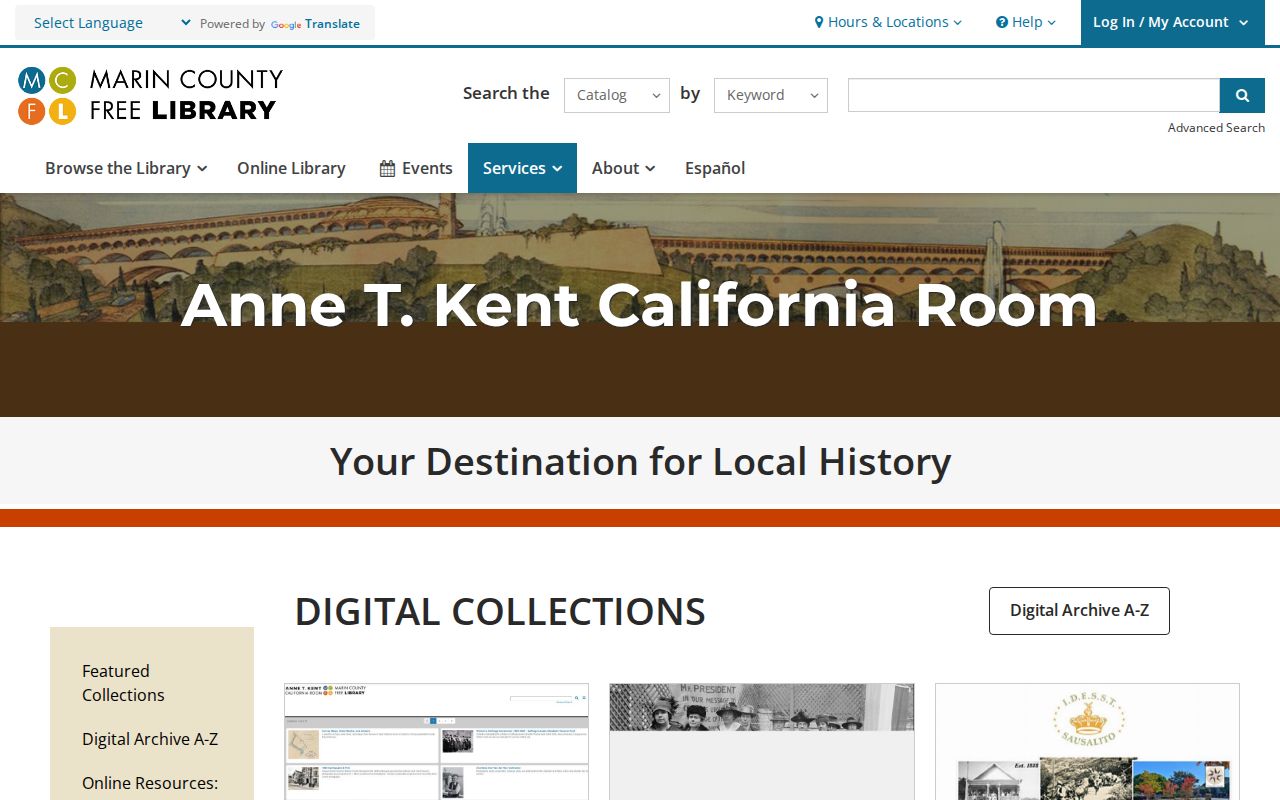
The image points to a research room where a printed entry can be read beside maps, newspapers, and family-history clues instead of being treated as a complete resident roll.
Note: Ask for the title, town, publisher, and year together because “Marin directory” can describe several different record series.
San Rafael's 1901 Marin County Directory
The complete 1901 San Rafael City Directory is unusually useful because its page images preserve more than an alphabetical name list. Directory Publishing Company of 310 Hayes Street in San Francisco assembled residents, classified businesses, fraternal societies, churches, government information, and a map. The book can therefore connect a person to an institution, a trade, a civic group, or a street context. It remains a San Rafael source, not a complete Marin County roll, and its categories should be kept distinct when a family search crosses town lines.
The online 1901 San Rafael directory reference gives access to the page sequence and makes it possible to inspect the printed neighborhood around a name. A useful pass starts in the resident section, records the spelling and address, then checks the classified and organization sections for the same surname. The map can help explain a place name, but it does not replace a parcel map or a recorded legal description.
The 1901 volume is also a reminder that “city directory” can mean a book with several research layers. A household may be represented by one head of household, a business may be listed under a firm name, and an organization may supply a second spelling or address clue. Compare the page date with a census year and with the next available local volume. Do not infer that every adult in a house was printed, or that an address proves ownership.
The digitized page itself is the useful visual record, so the 1901 San Rafael volume source page belongs beside the transcription notes.
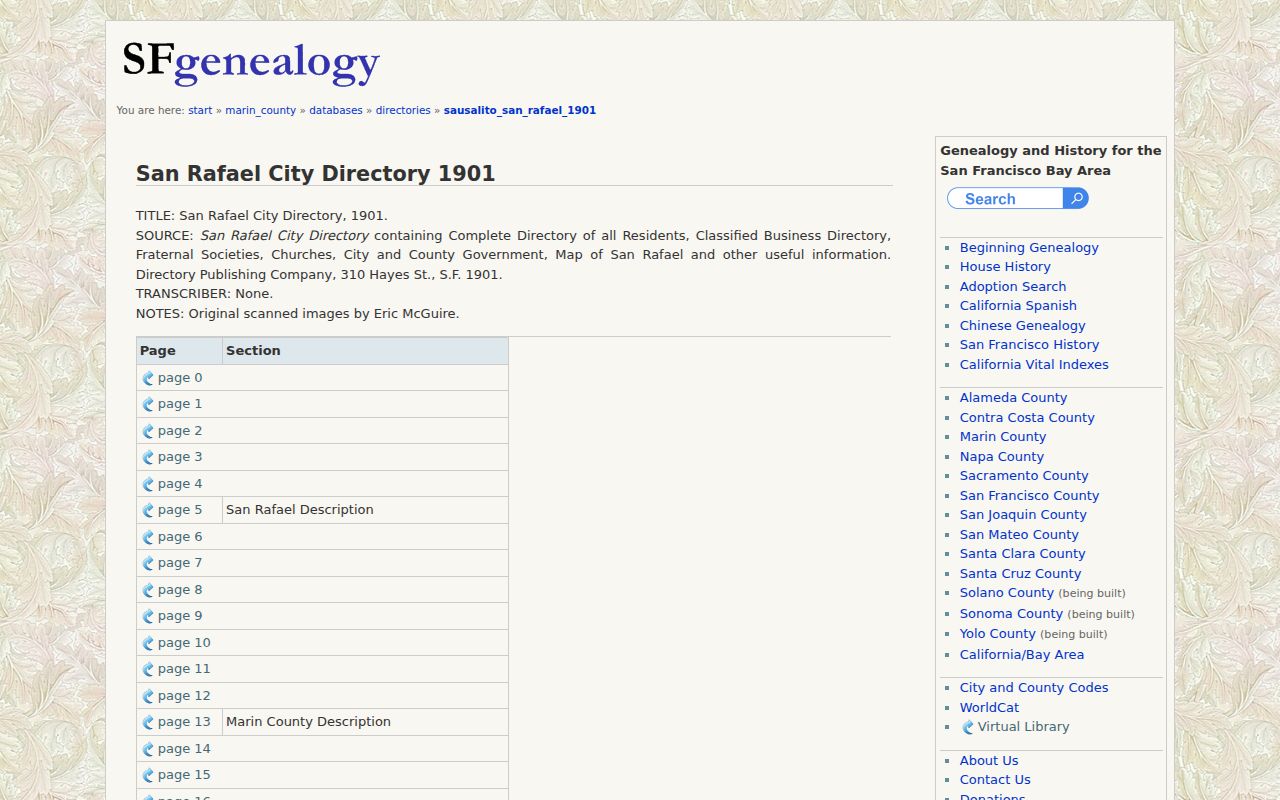
A page image preserves the order, abbreviations, and neighboring entries that a short name extract would leave out.
Marin County Telephone Directory Years
Telephone volumes fill a different role from a local directory. A city directory search should keep the town, exchange, and publication year in view. The Marin County ranges include March 1943 through March 1947, March 1948 through June 1950, May 1951 through May 1953, May 1954 through April 1955, and April 1960 through April 1961. Novato has its own runs from February 1947 through April 1958 and from April 1959 through April 1962. These dates are ranges of surviving volumes, not a claim that a book exists for every month in between.
The Marin County city-directory bibliography points to the relevant Library of Congress digitizations and records the San Rafael Ancestry editions. A county directory or telephone book can give a surname, given name, street, exchange, or number. It can omit unlisted subscribers, households without a listed line, and people who appear only in another town's book. A phone number is a period clue, not a current contact path.
Use the book's locality label exactly as printed. Marin's eastern corridor, Ross Valley, coast, ranches, and unincorporated communities do not fit one neat municipal index. A directory line under San Rafael can sit outside the incorporated city, while a town section can omit a rural address that appears in a county volume. The page keyword helps a searcher find the collection, but the year, publisher, exchange, and locality decide what the line means.
The photographed bibliography record at LDSGenealogy's Marin directory list is a quick way to compare surviving runs before requesting a library visit.
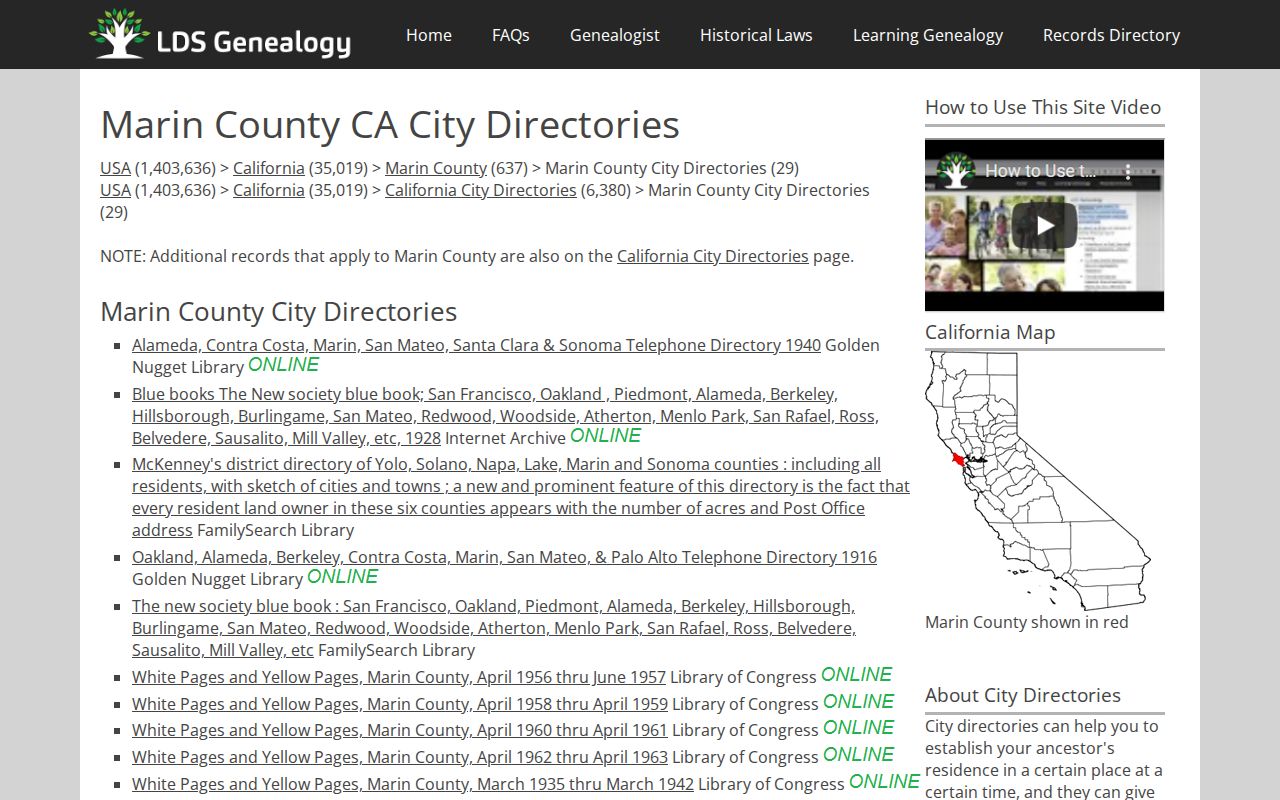
That visual reference helps separate a digitized phone-book range from a named local directory and keeps the source citation tied to the right year.
Reading Marin County Directory Entries
A printed entry has to be transcribed before it can be compared. In the inspected 1921-22 New Society Blue Book, a local directory line may include a surname, given name or initials, an honorific and household pairing, a suffix, a street or named place, corner notation, locality, and telephone exchange or number. The sample does not show an occupation. That absence is a feature of the volume, not proof that the person had no occupation or that the book was meant to be a census.
| Surname and given name | Preserve spelling, initials, punctuation, and name order exactly. |
|---|---|
| Household pairing | Honorifics such as “Mr. and Mrs.” may join adults without naming their relationship in full. |
| Address or named place | Use the street, corner, locality, or place name as printed. |
| Telephone clue | Record the exchange and number, which can distinguish similar names in one town. |
| Occupation field | Some publishers include a trade or occupation; the inspected Blue Book sample does not. |
- Criss-cross directory
- An address-order or street-order section that starts with a place and works toward an occupant name.
- Householder index
- An alphabetical entry point that usually names the listed head of a household or subscriber, not every person present.
- Abbreviation key
- The volume's guide to short forms, initials, exchange names, corner marks, and locality terms. Photograph or transcribe it first.
Owner and renter marks are not guaranteed across Marin runs. When a symbol or short form appears, check the publisher's key before assigning meaning. The same caution applies to “widow,” boarder, roomer, or spouse language. A directory entry is evidence about how a publisher described a person at one moment, not a legal finding about title or household membership.
Marin County Blue Book Directory Places
The New Society Blue Book is socially selective and should be read for its own purpose. The 1921-22 and 1928 material, along with the 1925 town sections, covers selected parts of Belvedere, Mill Valley, Ross Valley, San Rafael, Sausalito, and San Anselmo. Inspected entries pair surnames with honorifics, households, streets, corners, telephone details, or named places. Examples include Culloden Park, Golf Club Links, Marinita Park, and Quarry Side. Those names can be powerful map clues when a modern street search fails.
The Blue Book collection reference places the social directory in its historical setting. It is not a census, and it is not a complete resident directory. An entry can identify several adults, as the separate Bates entries at 739 Irwin do, yet another household may be absent because the publication selected its social scope. Pair the line with a census, deed, Great Register, newspaper, or obituary before drawing a family conclusion.
The named-place clues are the part most likely to be lost in a plain transcription, so the source record for Marin's Blue Book directories is worth checking beside a map or subdivision record.
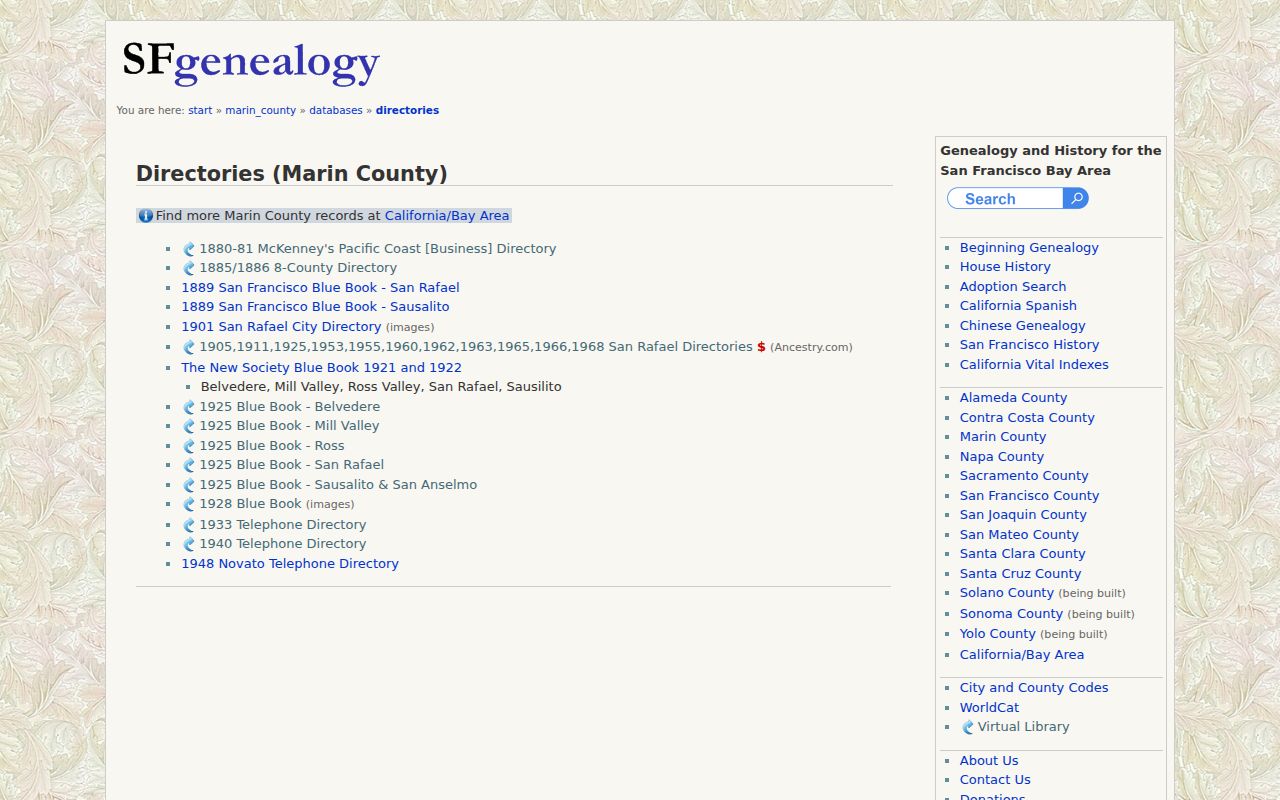
Named places show how Marin's older social geography could sit beside, but not match, later standardized street labels.
Insider tip: When a Blue Book line names a corner or place instead of a street number, search the locality and nearby surnames before assuming the address is missing.
Tracing Marin County Directory Households
A family-history search works best as a dated sequence, not a hunt for one perfect entry. Start with a spelling and locality that another record supports. Then use the Marin County city directory to test whether the person stayed in the same town, changed streets, appeared under a spouse, or moved into an adjacent edition. Great Registers and censuses supply anchors between directory years, while obituaries and probate can explain an abrupt stop.
- Choose the narrowest likely town, exchange, or named place and find the earliest plausible entry.
- Copy the full line, including initials, household pairing, address, locality, and telephone clue.
- Compare an earlier and later edition, then check the reverse or street section for the same address.
- Pair directory years with Marin censuses from 1850-1930 and Great Registers from 1906-1974 when the person qualifies for that record.
- Close a gap with the California Death Index, Marin County Farm Deaths, the I.J. biography and obituary index, newspapers, probate, or a deed.
The California Room's index to Great Registers from 1900-1932 and its later I.J. index can help distinguish a move from a death, but an index entry still needs a source review. A person who disappears may have moved, become unlisted, changed name, or fallen outside a selective edition. Check spelling variants, married or maiden names, initials, adjacent towns, and publication dates before treating absence as an event.
The library's history and genealogy resources connect directories with census, obituary, newspaper, and family-history tools. The companion image gives a visual cue for the broader research shelf.
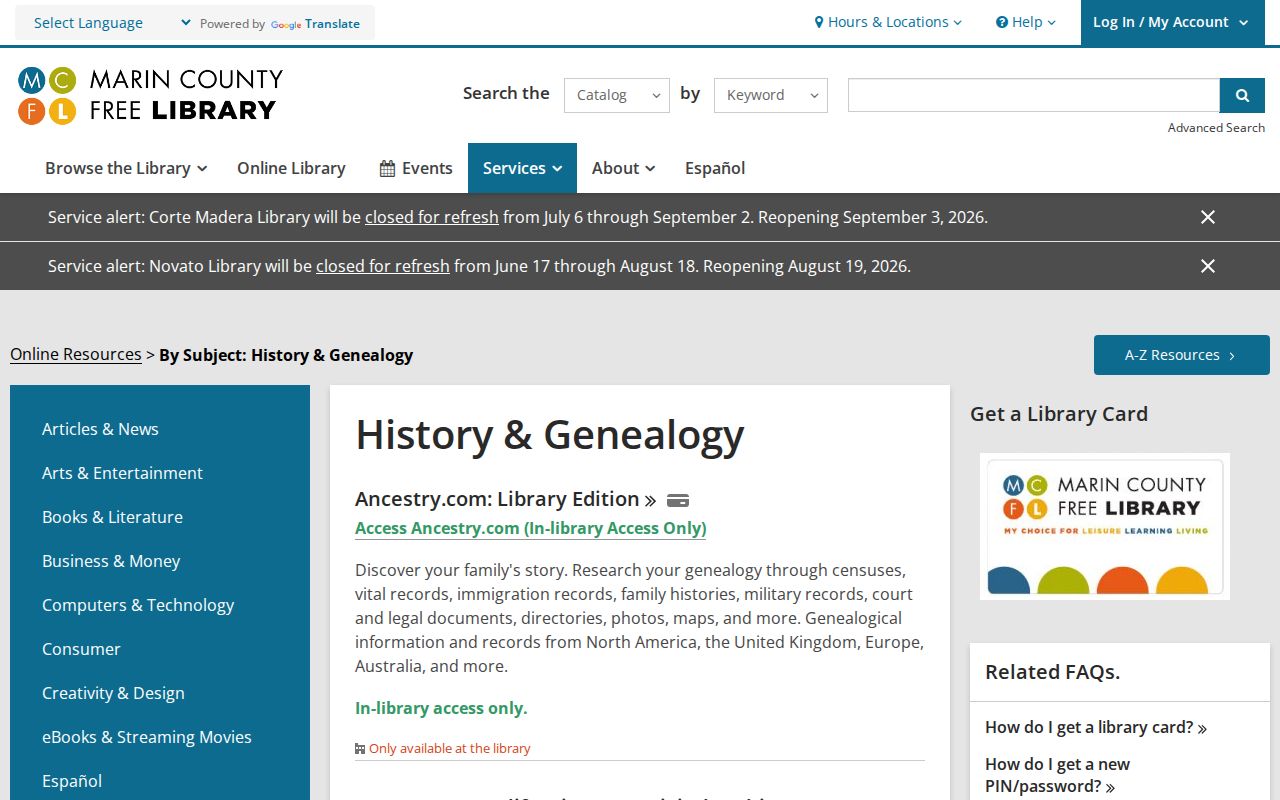
Use that wider collection context to test a directory clue rather than letting one printed line carry the whole family story.
Marin County Directory History at the Museum
The Marin History Museum Research Library adds material that a directory alone cannot supply. Its holdings include yearbooks, telephone directories, maps, manuscripts, newspapers, biographical files, and clippings. Research use is on site Wednesday and Friday from 11 a.m. to 3 p.m. or by appointment, with requests directed to research@marinhistory.org. A catalog search can identify a lead, but the material is used at the library and should be requested by title, person, place, or year.
Its institutional history is a useful local record story. Collections moved from the San Rafael Independent building in 1935 to San Rafael High School during World War II, then to Mission San Rafael in 1954 and Boyd Gate House in 1959. The museum reopened at Boyd Gate House with a Research Library in 2021. A family reference may therefore appear in a clipping, yearbook, map, or phone book even when a city directory is silent.
The Marin History Museum Research Library describes the catalog and the house-history material. It is a useful next stop when a directory clue points to a building, a school cohort, or a named community.
Marin County Directories Aren't Census Rolls
Every Marin County directory has a coverage rule, whether the rule is a publisher's town boundary, a telephone subscriber list, a business focus, or a selective social audience. A book may name a householder and omit a spouse, list a phone subscriber and omit a non-subscriber, or use a town label that now falls in an unincorporated area. A page image preserves what was printed, but it cannot prove that every resident was included.
Use the directory as one layer in a careful chain. A current question may need a parcel and recorded document; an old household question may need a census, obituary, church register, newspaper, or probate file. For modern address-keyed work, the Marin County by-street records page keeps the parcel and jurisdiction workflow separate from the historical shelf. When a historical name needs a present-day confirmation, a Marin County resident lookup can link the clue to the right record custodian without treating a directory entry as final proof.
Marin was established on September 16, 1850, and the county preservation program identifies 4,650 historic volumes dating to 1856. The FY2025-26 material reports 314 preserved volumes and 190 more scheduled for preservation. That timeline explains both the richness of the shelf and the unevenness of online access. A directory search is strongest when it cites the exact volume, keeps the locality in view, and leaves room for the record that has not yet been digitized.
Marin County's record-keeping history places the directory shelf in the larger sequence of Coast Miwok, mission, rancho, and American county records.