
Find Marin County Residents
The Marin County residents directory is not one countywide roster. It is a set of records with different custodians and different meanings. An assessor record can identify a parcel owner and a tax mailing address. A recorded deed identifies parties to an instrument. A court index can identify a case party. A directory entry can place a household at an address during a particular year. None of those roles, by itself, proves that every person at a property is a current resident.
Start with the strongest fact already in hand. An address points to MarinMap and an APN. A name may lead to the recorder, court, license, business, or vital-record system. A family-history question usually needs the California Room, historical society files, census material, and obituaries. A missing online result is a cue to change custodians, not proof that a person or property has no record.
- Locate the address in MarinMap, capture the APN, and identify whether the parcel is in a city or unincorporated Marin.
- Use the APN in the county assessor application, then keep the situs address separate from the mail-to name and mailing address.
- Search the recorder by party name and spelling variants, because its index does not accept a street address or APN.
- Check the Marin Superior Court ePortal, vital-record rules, or an official state lookup when the question concerns one person.
- For an older household, use the California Room, Marin History Museum, census, newspaper, and directory collections, then request a missing administrative record through Marin County’s public-record process.
That sequence turns a loose resident search into a dated evidence trail. It also makes clear when the search has reached a restricted record or a source that names an owner rather than an occupant.
Marin County Records Offices
Marin County combines the Assessor, Recorder, and County Clerk under the Assessor-Recorder-County Clerk, but each division answers a different question. The Recorder indexes deeds, liens, maps, and other instruments. The Assessor maintains parcel identifiers, assessment information, and maps. The County Clerk handles marriage, fictitious business name, and related filings. Elections holds controlled voter data, while Superior Court keeps probate and case files. The Marin County Assessor-Recorder-County Clerk is the useful starting point for several record types, not a single resident search box.
Marin County Recorder
3501 Civic Center Drive, Suite 232
San Rafael, CA 94903
415-473-6092
Marin County Assessor
Marin Civic Center public counter
San Rafael, CA 94903
415-473-6092
Marin Elections
3501 Civic Center Drive, Suite 121
San Rafael, CA 94903
415-473-6444
In-person help matters when an online index stops at a date, hides an image, or requires a record request. Room 232 is the Recorder’s location for older document research, and the county’s civic-center campus places several custodians close together. The responsible office still controls access, certification, redaction, and correction.
Why Marin County Records Split
Marin is a county of eleven incorporated municipalities: Belvedere, Corte Madera, Fairfax, Larkspur, Mill Valley, Novato, Ross, San Anselmo, San Rafael, Sausalito, and Tiburon. It also includes many unincorporated communities. A postal place can cross a city limit, service district, school boundary, or assessor tax area. That is why a permit, court, tax, deed, election, or historical question may move between county, city, state, and federal systems.
The same name can appear as a grantee, a taxpayer, a case party, a business agent, a directory resident, or a voter. Those are evidence labels, not interchangeable identities. The Marin County residents directory becomes more reliable when each result keeps its source, date, role, and custodian attached.
| Official source | Best question | Important limit |
|---|---|---|
| Assessor roll | Which parcel and taxpayer record are connected? | Mailing address is not proof of residence. |
| Recorder index | Which parties signed or received a recorded instrument? | Index is not the deed image and cannot search by address. |
| Directory or census | Who was listed at an address in an earlier period? | Unlisted households and gaps are common. |
| Commercial compilation | What lead might need checking? | Names and addresses can be stale, merged, or mislabeled. |
Official does not mean complete, and a compiled result does not become official because it looks current. The record trail decides what a finding can support.
Start With Marin County Records
Marin’s public assessor application is APN-first. It does not provide a public owner-name or street-address directory. The APN is the stable bridge from a map to a roll, but it is an assessment locator rather than a postal address or full legal description. The county example uses an eight-digit pattern such as 123-456-48. The first three digits identify the map book and the next two identify the page, which helps a researcher open the right scanned parcel map.
Accept the application’s Revenue and Taxation Code warning before searching. The roll can contain situs, mail-to, value, use, units, exemptions, and roll-year fields, but property characteristics are prepared for assessment and are not continuously updated. Carry the APN into the Recorder, county permit viewers, and a city system only after checking jurisdiction.
| Parcel Number | Required for roll lookup; use the county’s eight-digit APN format. |
|---|---|
| Map Book | Required for map lookup; the first map-reference component. |
| Map Page | Added when a specific scanned map sheet is needed. |
| Accept / Decline | Accept opens the search; decline does not. |
| Result limit | The public application can cap a search at 100 results. |
- Roll
- An assessment record describing a parcel, its taxable values, use, and related mail-to fields for a roll year.
- Index
- A finding aid that points to a fuller record; it is not the deed, court file, or certificate itself.
- Parcel
- A mapped unit of land identified by an APN, which can change when land is split or combined.
- Criss-cross directory
- An address-order directory that works from a place toward an occupant name rather than from a name toward an address.
Note: An APN organizes Marin County property research, but it does not identify every person who occupies the parcel.
Marin County Parcel Records
Use MarinMap to turn an address into a map feature before opening an assessor record. Search the place or address, select the suggested location, turn on parcel and address layers, and click the polygon. The popup can supply the APN and surrounding geography. Zoom and pan along a street to compare adjacent parcels. Measure tools give context only. Marin GIS warns that its maps are informational and not survey accurate, so a map display is not a boundary survey or title proof.
Jurisdiction is the second result to capture. A postal San Rafael address may be within San Rafael or unincorporated Marin. The 94941 postal area reaches beyond incorporated Mill Valley, and 94965 joins Sausalito with unincorporated Marin City. County CDA viewers serve unincorporated property; a city or town system serves land inside municipal limits. The address, APN, postal label, and permit keeper should all be written down.
Address → MarinMap parcel → APN and jurisdiction → assessor roll → recorder name search → permit or directory evidence.
Marin GIS also publishes roads, zoning, hazards, districts, aerial imagery, and other open-data layers. Those layers add context to a resident search without turning the map into a household list.
Note: Carrying the APN downstream avoids false matches caused by unit numbers, directional prefixes, street suffixes, and postal place names.
Current Marin County Resident Sources
Current sources in the Marin County residents directory have different access rules. A residents directory result is useful only when its source role is kept clear. The assessor application starts with a parcel number. The Recorder’s Official Records Search is a free index, but the underlying image is not the same as the index. California’s My Voter Status tool is an identity-matched self-check, not a reverse directory. A court result is a case record, not a residence record. The library and historical society are essential when “current” means a recent past rather than today.
| Source | What it can connect | Keeper | Access posture |
|---|---|---|---|
| Assessment roll | APN, situs, owner/mail-to fields, values and use | Marin Assessor | APN web search; broader data may require counter or request. |
| Recorded index | Grantors, grantees, dates, document references | Marin Recorder | Free index; paid copies and older-room research. |
| Voter status | One voter’s registration and election status | California Secretary of State | Identity-matched self-lookup; bulk data is restricted. |
| Superior Court index | Case parties, numbers, events and eligible documents | Marin Superior Court | Account, daily limit, and case-type restrictions. |
| Local collections | Past households, relatives, places, and obituaries | California Room and Marin History Museum | Online catalogs, digitized items, email, or on-site use. |
Use the source that matches the question, then verify with a second independent anchor such as an age, middle name, old address, relative, or dated document. That habit is more useful than collecting a long list of unverified names.
Marin County Recorder Records
Marin’s Recorder index works like a catalog. Search party names, document references, book and page information, or document and map criteria, then try every reasonable spelling variant. It does not accept a street address or APN. The access map places the online index from January 2, 1973 forward; older documents must be pursued in Recorder Room 232 at the Civic Center. The index can point to a deed, deed of trust, reconveyance, lien, release, easement, notice, or recorded map, but the index alone does not establish possession or occupancy.
The online result should be read as a set of clues: party and role, instrument type, recording date, reference number, book and page or map reference, and any cross-reference. A legal description, vesting language, signature, and full parcel relationship require the paid instrument or a counter inspection. Official-record copies cost $4 for the first page and $2 for each additional page, with $4 for certification. Map copies cost $5 per page, with $4 for certification, and certified copies cannot be emailed. The Recorder document and map order form provides the separate request path.
The recorder screenshot below is linked to the live index so its search modes remain tied to the custodian rather than a copied directory.
Open the Marin County Recorder’s Official Records Search to see the index entry point.
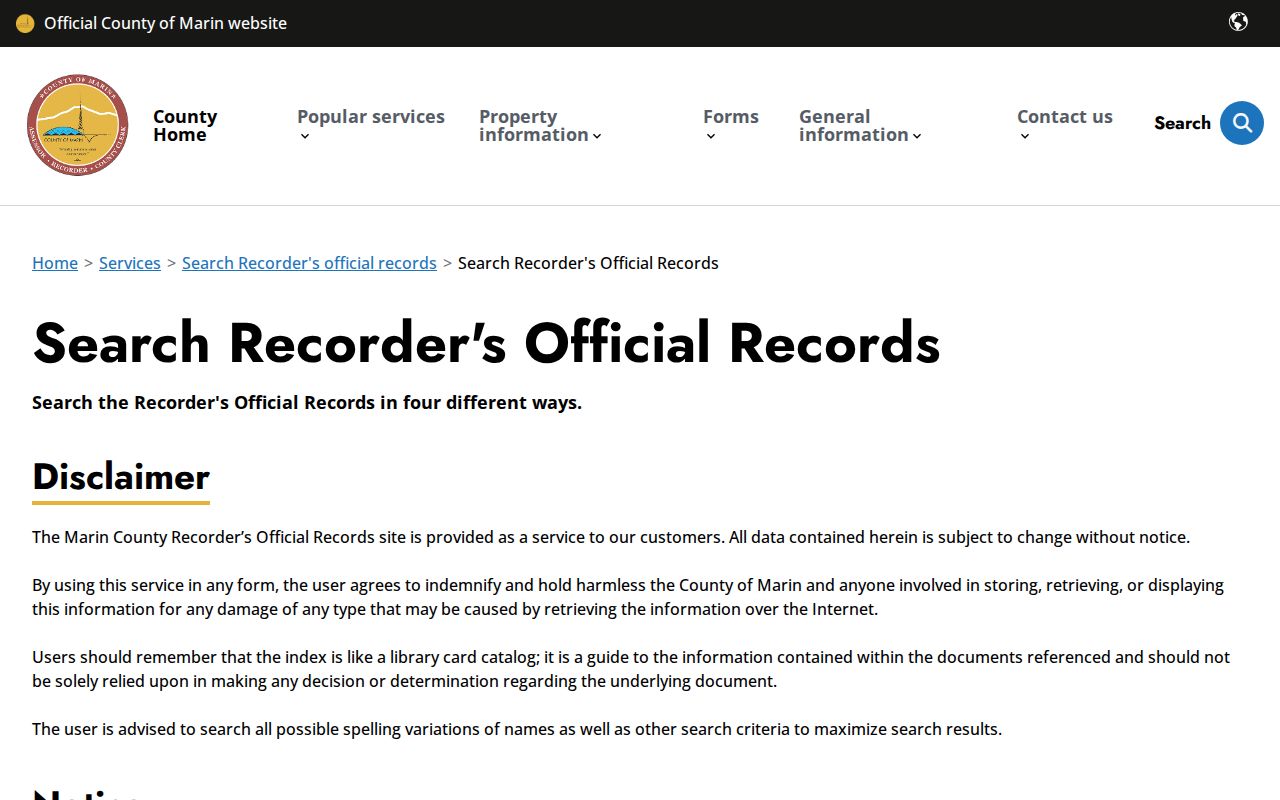
The image illustrates the catalog step. A name result still needs a dated instrument, legal description, and a second source before it can support a resident-history conclusion.
Note: A free index entry and a certified copy answer different questions, so record both the reference and the access level.
Marin County Voter Records Limits
California My Voter Status is useful when a person checks their own registration. It asks for identity fields and can return personal registration status, party preference, county, districts, precinct, and election information. It cannot be browsed by street, ZIP, or block as a public resident list. Marin treats underlying voter data as restricted public information, not as a casual lookup tool.
An approved election, political, scholarly, journalistic, or governmental requester must submit identity and contact information, purpose, requested geography or product, supporting material, original signature, date, and a security acknowledgment. A request for specific voters may cover no more than ten people. Review can take up to ten business days, and approved active-voter data arrives through secure delivery as tab-delimited text or PDF. Protected Safe at Home and confidential voters remain shielded, and ballot choices are never supplied.
The California My Voter Status lookup should therefore be described as a self-service status check. It is not a substitute for a voter roll and it should never be used to infer a person’s ballot choices or current household.
View the California voter-status form for the identity-matched route. The linked capture shows why a person’s own inputs are required.
The state form belongs to the voter, while Marin’s controlled file process belongs to approved statutory-purpose requests. Keeping those routes separate protects both accuracy and privacy.
Confirm Marin County Court Records
Marin Superior Court’s ePortal can connect a name to a case party, AKA, case number, case type, filing date, register-of-actions events, hearings, status, disposition, and eligible documents. The public route requires an account and login, and general users are limited to 45 cases per day. The court warns that new filings may lag and that remote access is narrower than courthouse access. California does not provide one statewide trial-court party-name search, so a Marin trial matter remains with Marin Superior Court.
The portal changed in 2023. Specified criminal matters after June 20, 2023 are handled in the current ePortal, while earlier criminal matters may remain in EJUS. Sealed files, juvenile matters, adoption and parentage records, protected filings, and other confidential material are excluded. A courthouse terminal may show a document that cannot be displayed remotely. Use the public index to identify the case number and title before requesting pages from the clerk.
Marin Superior Court online services provide the official entry point. The screenshot below is a visual reference to that gateway, not a replacement for the court’s live access rules.
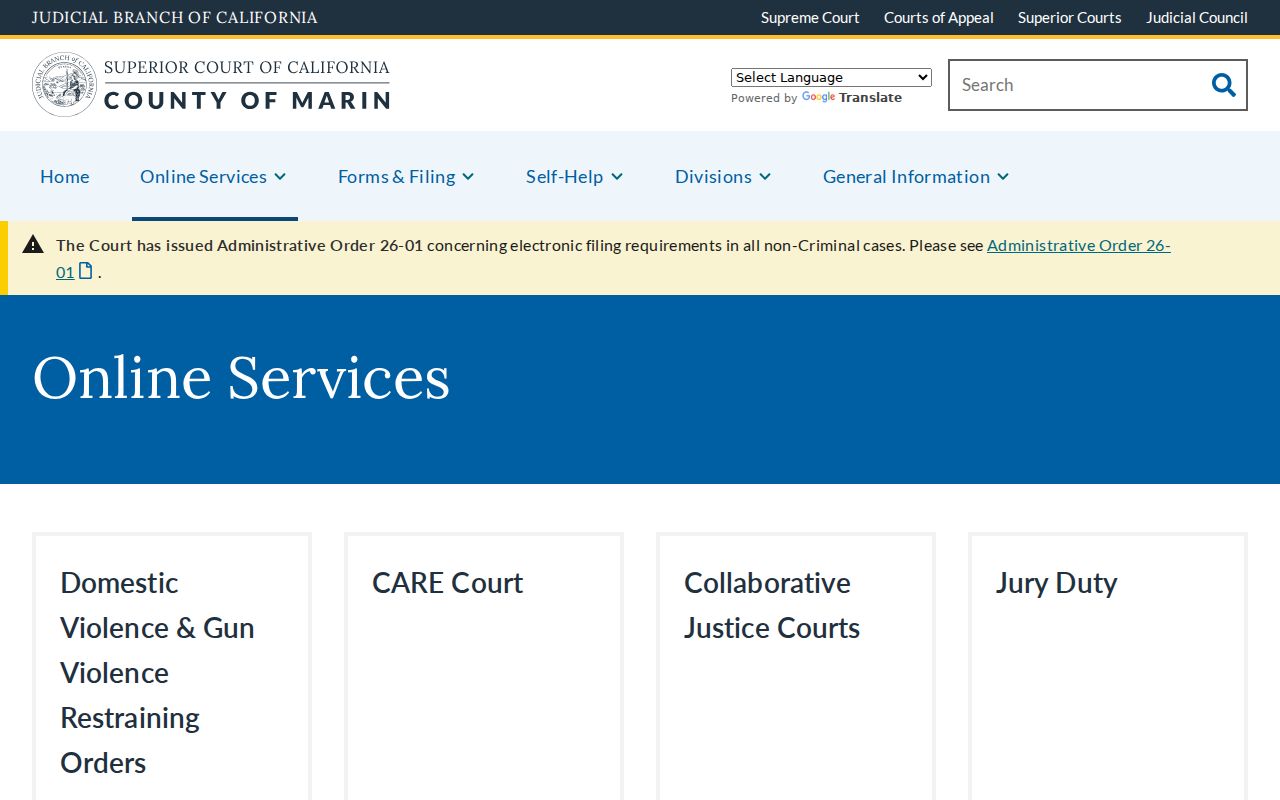
Room 113 and the court’s physical or mail request process remain fallback channels. A search longer than ten minutes or an estate search is listed at $15, copies are $0.50 per page, comparison is $1 per page, certification is $40 per document, and certified dissolution records are $15. Those charges apply to court service, not to a general resident lookup.
Note: A court party is evidence of a case relationship, not proof that the person lives at a Marin County address today.
Marin County Vital Records Clues
Marin’s Recorder issues birth and death certificates for events in Marin from the 1850s to the present, along with public marriage certificates for licenses registered in Marin. The newest six weeks of births and deaths may be held only by the Marin Office of Vital Statistics. The state Department of Public Health is the statewide custodian and handles forms and access rules for records outside Marin. Divorce certificates are not the same as a full Superior Court decree.
Authorized copies can establish identity for eligible applicants. Informational copies are certified but marked that they are not valid documents to establish identity. Confidential marriage records generally go only to a spouse or a court-order recipient. A mailed authorized request needs a signed, notarized sworn statement. In 2026, the listed copy fees are $31 for birth, $26 for death, $19 for public or confidential marriage, and $18 for a CDPH divorce certificate.
Vital records are strongest for family-history questions when paired with a dated address, obituary, deed, or probate record. They do not create a public list of living Marin County residents. The state’s California Vital Records information explains the ordering route and copy distinctions.
Marin County Family Records
The Anne T. Kent California Room connects the Marin County residents directory with a long historical shelf: business directories and phone books from 1878 to the present, Great Registers from 1906 to 1974, the Great Register index from 1900 to 1932, the volunteer I.J. biography and obituary index from 1970 forward, Marin censuses from 1850 to 1930, the California Death Index from 1940 to 1994, farm deaths from 1881 to 1965, and the WPA-era Flack’s Chronology index. Its local-history and genealogy resources can also point to maps, yearbooks, newspapers, oral histories, and digitized items.
Marin History Museum adds phone directories, yearbooks, biographical and clipping files, maps, manuscripts, and newspapers. Its research library uses material on site, accepts research requests, and offers visits on Wednesday and Friday from 11 to 3 or by appointment. These collections are useful when a person is absent from a current roll, when a street name changed, or when a family trail runs through a ranch, school, club, or newspaper notice.
Marin History Museum’s research library provides the linked collection context.

The library image points toward the shelf behind a historical name search. A directory, obituary, or clipping is a lead that gains strength when its place and date match a deed, census, or certificate.
Historical Marin County Directories
The historical side of the Marin County residents directory begins with business directories and phone books held through the California Room. The collection includes McKenney’s eight-county directory from November 1883, a complete 1901 San Rafael City Directory, Kingsbury’s 1905-06 edition, county runs in 1942-43, 1946-47, 1949-50, 1952-53, 1954-55, and 1957-58, and San Rafael editions through 1968. Novato phone books add a separate town trail. The 1921-22 New Society Blue Book and its later town sections are selective social directories, not a census.
A directory year can place a named household at a street, corner, telephone exchange, or named place. It can show a move between editions, a business connection, a spouse pairing, or a neighborhood cluster. It cannot show every renter or unlisted household. The complete collections, sample entries, and tracing method belong on the Marin County city directories page, where the shelf and digital access routes are treated in detail.
Marin County Directory Volume Gap
Marin was established on September 16, 1850, but a county’s creation date does not mean every early record is online or preserved in one series. The Assessor-Recorder-County Clerk preservation program identifies 4,650 historic volumes dating to 1856, including maps, deeds, and ownership or encumbrance records. Reports for FY2025-26 identify 314 volumes, or 6.5 percent, as preserved and 190 more scheduled for work. Preservation changes what can be viewed, but it does not turn the web index into the full land-record universe.
The gap explains why a modern name search can end abruptly. Older deed books, map references, directory years, and local newspapers may require a room visit, staff request, microfilm or a digitized collection. A careful Marin County residents directory entry states the coverage boundary rather than smoothing it over with a guessed date.
- Write down the latest verified source and its date.
- Ask the custodian which older series or physical index continues the trail.
- Compare the old reference with a map, directory, census, obituary, or probate record.
Marin County Public Records Requests
When a county administrative record is not in a specialized portal, the California Public Records Act is the fallback. Government Code §§7920.000 through 7931.000 permits any person to request reasonably described, nonexempt records. Marin ordinarily must determine whether the request seeks disclosable records within ten days. Written notice of unusual circumstances may add no more than fourteen days to that determination. The deadline is not a promise that every record will be produced immediately.
Inspection is normally free. Duplication charges are limited to direct costs unless another law controls, and electronic records generally should be supplied in an electronic format the agency uses when that format is requested. Marin’s NextRequest portal accepts anonymous requests. A request should identify the department, record type, date range, address or APN when relevant, and preferred format. A CPRA request is not a substitute for ordering a certified deed, vital certificate, or court record from its custodian.
Use Marin County’s public-record request instructions and its NextRequest portal when a county administrative record has no better access route. A precise request is easier to answer than a demand for a complete resident list.
Protecting Marin County Residents
Public access has limits. California’s Safe at Home program provides an enrolled participant with a substitute mailing address; it is not a retroactive eraser for material already published online. Voter street address, phone, email, identifying numbers, signature, and related fields are restricted except for controlled statutory access. DMV information, utility records, delivery subscribers, unnamed household members, and private association or congregation membership are not open substitutes for a resident roll.
California’s CCPA and CPRA provide rights to know, access, delete subject to exceptions, correct, opt out of sale or sharing, and limit some sensitive-information uses. The state DROP process allows one deletion request to registered data brokers, with broker processing beginning August 1, 2026. Those commercial deletion tools do not erase lawful county deeds, court filings, or historical books. Check the custodian when a record is wrong, and use public information only for lawful personal, family-history, civic, or safety research.
Lawful use matters. Do not use a Marin County residents directory result to stalk, harass, intimidate, or harm anyone. California Penal Code section 646.9 and Code of Civil Procedure section 527.6 address serious conduct and protective remedies; a person who needs immediate help should contact local law enforcement.
The useful finish to a resident search is a verified record and a clear boundary around what remains private. That is the standard for every name, address, and historical entry.